

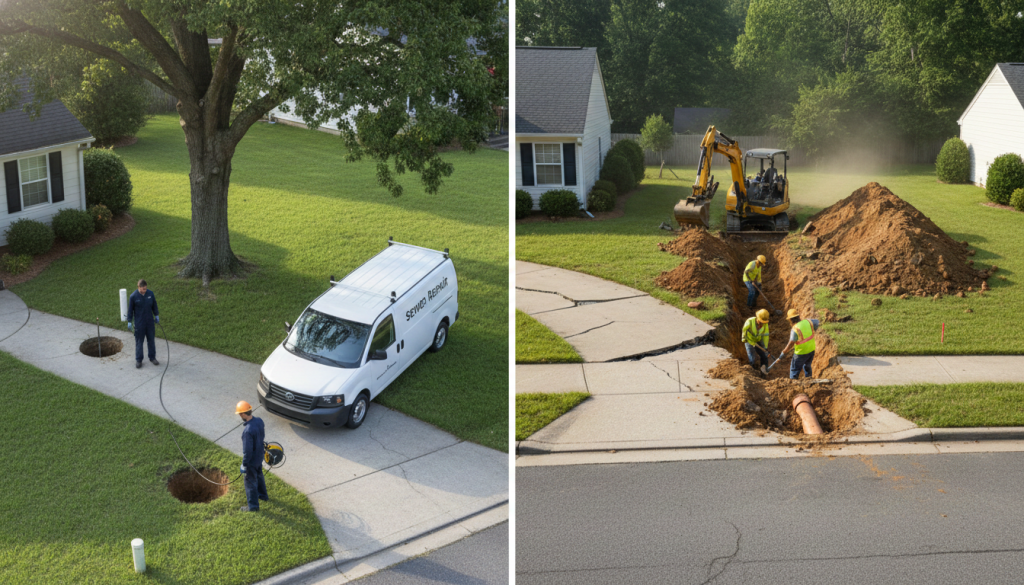
For most Charlotte, NC homeowners, trenchless sewer repair costs less overall than traditional digging once you include yard, driveway, and landscaping restoration — even though the per-foot price looks higher upfront. Trenchless typically runs $80–$250 per linear foot and finishes in 1–2 days, while traditional excavation costs $50–$200 per foot for pipe work alone but adds thousands in concrete, sod, and hardscape repair on top. The right choice depends on the condition of your pipe, which a camera inspection from Pipeworks Plumbing & Drain will confirm before any work begins.
What’s the difference between trenchless and traditional sewer repair?
Traditional excavation (the old “dig-and-replace” method) requires a crew to dig a trench 3–6 feet deep along the entire length of your damaged sewer line. The old pipe is removed, a new one is installed, the trench is backfilled, and the surface — your driveway, walkway, lawn, garden bed, or all of the above — has to be rebuilt afterward.
Trenchless sewer repair restores the line from the inside through one or two small access points, usually at existing cleanouts. It uses one of two main techniques:
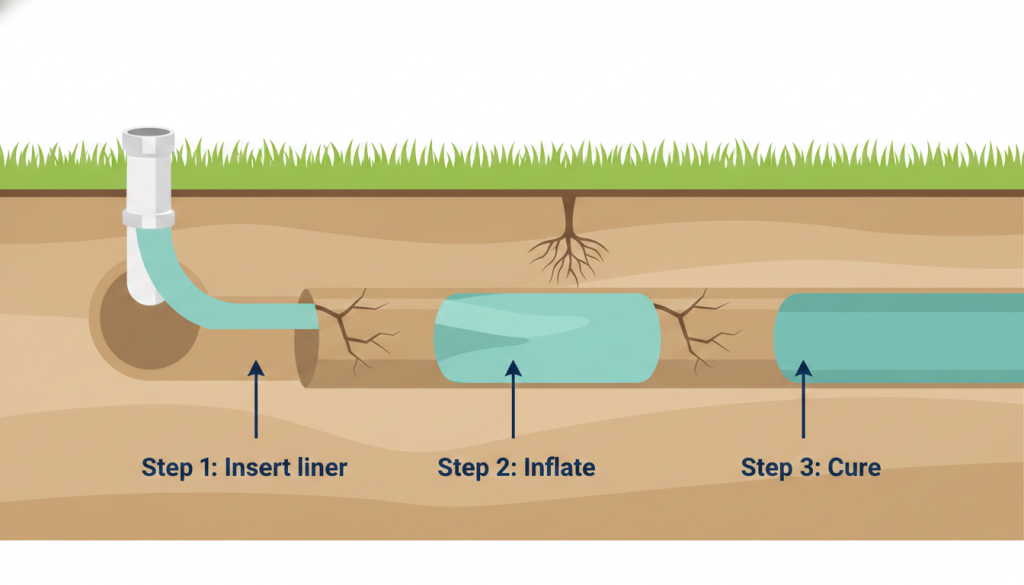
- Pipe lining (CIPP — Cured-In-Place Pipe): A flexible felt or fiberglass liner soaked in epoxy resin is pulled into the existing pipe, inflated against the inner wall, and cured into a smooth, seamless new pipe. CIPP is one of the most established trenchless rehabilitation methods worldwide and has been used for residential and municipal sewer renewal since the 1970s. (See the Frontiers in Water peer-reviewed review for the full technical background.)
- Pipe bursting: A bursting head fractures the old pipe outward into the surrounding soil while simultaneously pulling a new HDPE pipe into place behind it. This is the right call when the existing pipe is too damaged to line.
The bottom line: traditional digging replaces the pipe by removing it. Trenchless replaces or rehabilitates the pipe by working inside it. Same end result — drastically different impact on your property.
How much does each method cost in Charlotte, NC?
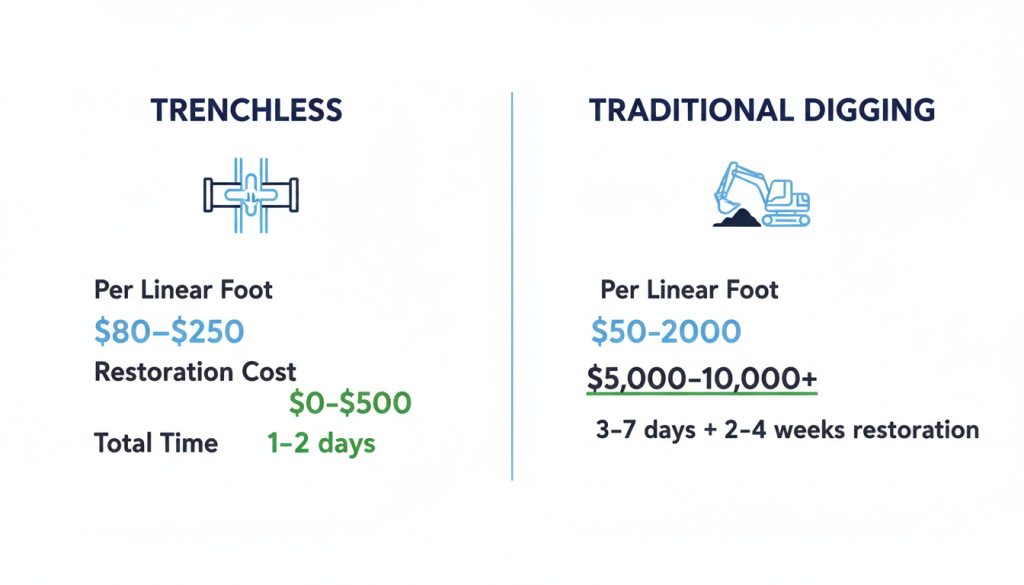
Real, current price ranges for the Charlotte and broader Carolinas market:
| Cost Factor | Trenchless Sewer Repair | Traditional Excavation |
| Pipe work (per linear foot) | $80 – $250 | $50 – $200 |
| Average residential project total | $8,000 – $15,000 | $5,000 – $20,000+ (with restoration) |
| Concrete driveway restoration | Usually $0 | +$1,500 – $4,000 |
| Sod & landscaping restoration | Minimal | +$500 – $3,000+ per mature tree, $0.35–$0.85/sq ft for sod |
| Permit costs | Up to $1,000 | Up to $1,000 |
| Camera inspection (required first) | $175 – $350 | $175 – $350 |
These numbers are aligned with current industry data published by Angi’s 2026 trenchless sewer line cost guide and recent contractor analyses across the Carolinas.
Why the per-foot price doesn’t tell the whole story: traditional excavation looks cheaper at first glance, but the restoration costs are usually invisible until the bid is final. If your sewer line runs under a concrete driveway, mature oak trees, or a cured patio — common in older Charlotte neighborhoods like Plaza Midwood, Dilworth, or Myers Park — restoration alone can add $5,000–$10,000 to the project. Trenchless avoids almost all of that.
For deeper context on the related plumbing services that may come up during a sewer repair project, see our pages on sewerage maintenance & repair and hydro jetting.
What are the pros and cons of trenchless sewer repair?
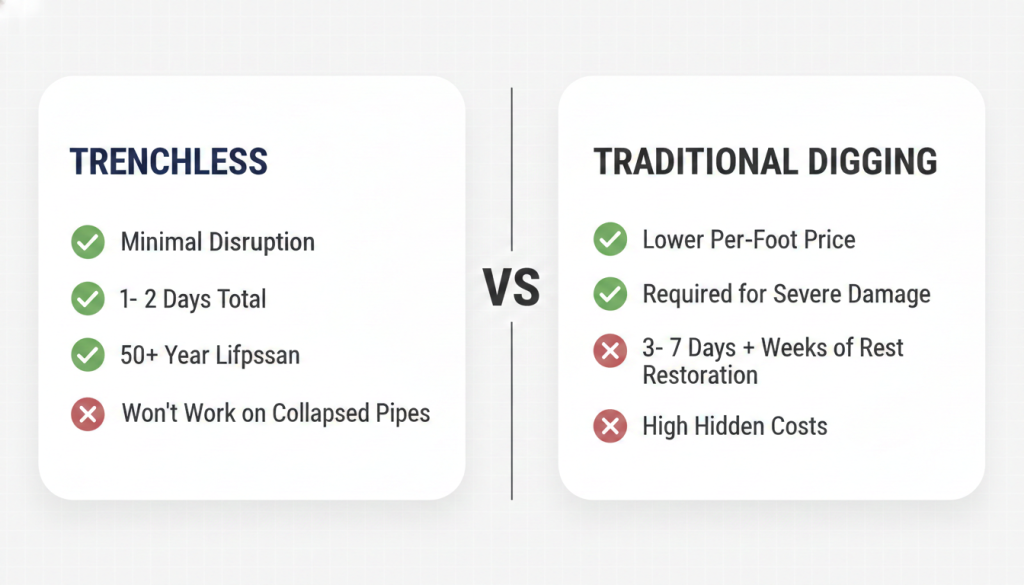
Pros:
- Minimal property damage — only one or two small access points needed
- Faster turnaround — most jobs done in 1–2 days, no waiting weeks for sod or concrete to cure
- Lower total project cost in most cases once restoration is factored in
- Long lifespan — CIPP liners are typically rated for 50+ years
- Corrosion-resistant — the new liner is seamless and resists root intrusion better than older clay or cast iron joints
- Eco-friendlier — significantly reduces excavation waste, soil disruption, and equipment emissions, as documented in a 2025 peer-reviewed study published in MDPI Applied Sciences comparing emissions from CIPP versus open-cut methods
Cons:
- Higher per-foot price on the repair itself
- Requires specialized equipment and trained technicians (not every plumber offers it)
- Won’t work if the existing pipe is fully collapsed, severely misaligned, or off-grade
What are the pros and cons of traditional excavation?
Pros:
- Lower per-foot pipe cost for short, accessible runs
- Required when a pipe is fully collapsed, badly off-grade, or needs route re-engineering
- Allows direct visual inspection of soil conditions during the dig
- Works regardless of pipe diameter, material, or configuration
Cons:
- Major property disruption — driveways, walkways, lawn, landscaping, and sometimes mature trees all get torn up
- Longer timeline — 3–7 days for the dig itself, plus 7–28 days for concrete to cure and 2–3 weeks for sod to take root
- High restoration costs that aren’t always quoted upfront
- Higher risk of disturbing other underground utilities
- Heavy equipment, noise, and dust for the duration of the job
How long does each method take?
| Phase | Trenchless | Traditional |
| Camera inspection | Same day | Same day |
| Repair work | Few hours to 2 days | 3–7 days |
| Surface restoration | None to minimal | 2–4 additional weeks (concrete cure, sod root-in) |
| Total time before normal use of yard/driveway | 1–2 days | 3–6 weeks |
For a working family in Charlotte, this difference is huge. Trenchless means your driveway is usable the same evening. Traditional excavation can mean parking on the street for a month while the new concrete cures.
Which sewer repair method lasts longer?
Both methods can last 50+ years when installed correctly. The U.S. EPA has formally evaluated CIPP as a proven rehabilitation technology for water and wastewater systems, and modern CIPP liners are typically designed for a 50-year service life — comparable to or better than a freshly excavated PVC sewer line in most residential conditions.
The bigger lifespan question is what’s already underground. If your existing line is Orangeburg pipe or aging cast iron — both common in older Charlotte homes built before 1980 — a CIPP liner will likely outlast the original by decades. Browse our pipe materials overview if you’re not sure what you have.
When is trenchless NOT the right choice?
Trenchless isn’t a fit for every situation. You’ll need traditional excavation if:
- The pipe has fully collapsed — there’s nothing left for a liner to bond to or a bursting head to push through
- The line has severe back-pitch or grade issues that need to be re-engineered
- The pipe has major offsets or misalignment beyond what bursting can correct
- The line is very short and very shallow in open ground, where the cost of trenchless mobilization outweighs the benefit
- An honest contractor — Pipeworks included — will recommend traditional digging over trenchless when that’s actually what your pipe needs. The decision should always be driven by what the camera shows, not by what’s easier to sell. (See our recent customer reviews for how we approach diagnosis.)
Is trenchless sewer repair worth it for Charlotte homeowners?
For the majority of Charlotte properties — especially those with finished driveways, mature landscaping, or detached structures over the sewer line — trenchless is worth the slightly higher per-foot price. The savings come from everything you don’t pay for: concrete demo and replacement, tree removal, sod, irrigation lines, and weeks of disruption.
It’s also why the Charlotte trenchless sewer repair page at Pipeworks always starts with a camera inspection — it’s the only way to know which method actually fits your pipe.
If you’ve spotted the warning signs of a failing sewer line — slow drains across multiple fixtures, gurgling toilets, sewage smell in the yard, or unexplained wet patches — get the camera inspection scheduled before the problem gets worse and your repair options narrow.
Call to Action
Not sure which method your sewer line needs? Pipeworks Plumbing & Drain has been serving Charlotte and Mecklenburg County with trenchless sewer repair, traditional excavation, and full sewer diagnostics. Every job starts with a camera inspection so you know exactly what you’re paying for — and which method genuinely fits your situation.
📞 Call (704) 555-0000 or request a sewer camera inspection online →
Conclusion / TL;DR
- Trenchless sewer repair in Charlotte typically costs $80–$250 per linear foot with minimal property disruption, finishes in 1–2 days, and lasts 50+ years.
- Traditional excavation runs $50–$200 per linear foot for pipe work alone, but restoration costs frequently add $5,000–$10,000+ for driveways, sod, and landscaping.
- Trenchless wins on total project cost for most Charlotte homes — especially properties with concrete driveways or mature landscaping.
- Traditional digging is still required when a pipe is fully collapsed, badly off-grade, or severely misaligned.
- Always start with a camera inspection. The condition of your pipe — not the contractor’s preferred method — should determine the repair.