

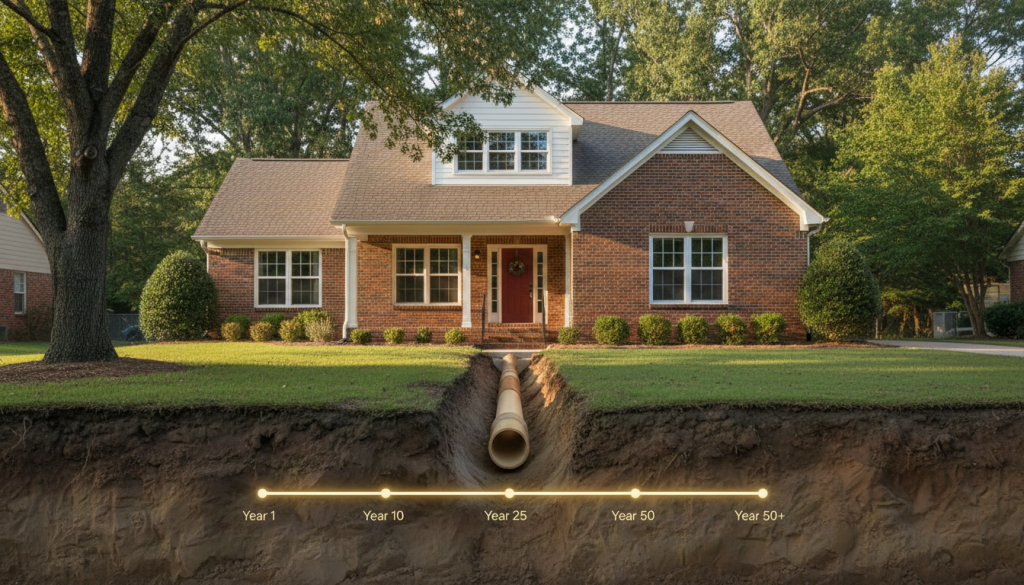
A properly installed trenchless sewer repair lasts 50+ years — engineered to the same lifespan as a brand-new sewer pipe. Both main trenchless methods, CIPP (cured-in-place pipe) lining and pipe bursting, are rated for a minimum 50-year design life under the ASTM F1216 international engineering standard. Real-world performance depends on three things: the condition of the host pipe before lining, the soil and ground stability, and the installer’s adherence to ASTM specifications. Most reputable Charlotte contractors back trenchless work with 10–25 year warranties, even though the liner itself is built for half a century. Before choosing a contractor for trenchless sewer repair in Charlotte, ask three questions: ASTM compliance, warranty length, and warranty transferability.
What’s the engineered lifespan of trenchless sewer repair?
A modern trenchless sewer repair — whether CIPP lining or pipe bursting — is engineered for a minimum 50-year service life. That figure isn’t a marketing claim. It’s the design specification written into the international engineering standard (ASTM F1216) that governs how trenchless liners are made, installed, and tested.
In practice, most residential trenchless installations in normal soil conditions deliver 40–60 years of service, with many systems projected to reach 100 years or more when the host pipe was in good condition before lining and the installer followed ASTM specifications. That’s comparable to — and often longer than — the lifespan of a freshly excavated PVC sewer line.
The short version: trenchless isn’t a patch. It’s a structural pipe replacement that happens to be installed without digging.
Where does the 50-year number actually come from?
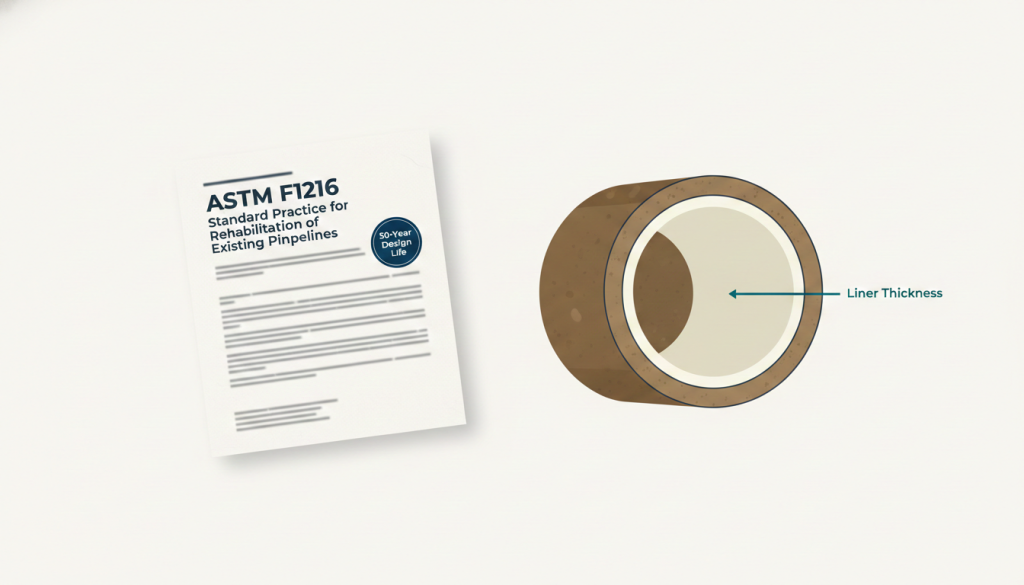
This is the part most contractor websites skip — and the part that actually gives the 50-year claim its credibility.
The number comes from ASTM F1216, the Standard Practice for Rehabilitation of Existing Pipelines and Conduits by the Inversion and Curing of a Resin-Impregnated Tube, published by ASTM International. ASTM is the global engineering body that sets material and testing standards across industries from aerospace to construction. Their CIPP standard specifies:
- Material requirements for the felt or fiberglass liner
- Resin chemistry and curing specifications
- Long-term flexural modulus testing (the liner has to maintain its structural strength over decades of stress, verified through 1,000+ hour creep testing per ASTM D2290)
- Installation procedures and post-cure inspection
- Minimum 50-year design life as the baseline performance target
A CIPP liner installed to ASTM F1216 specifications is classified as a fully structural pipe replacement — meaning it doesn’t rely on the old host pipe for strength after curing. The new liner is the new pipe.
This is why municipal contracts, including specifications from cities like Greenville, NC and DeKalb County, Georgia, require a 50-year minimum design life on every CIPP installation. If utilities are willing to sign 50-year specs on million-dollar municipal projects, the same engineering applies to your residential lateral.
The follow-up question to ask any Charlotte contractor: “Is your installation done to ASTM F1216 standards, and can you document the resin and liner specifications you use?” A reputable installer will say yes without hesitating. Pipeworks does — see the documentation approach reflected in our customer reviews and testimonials.
Does CIPP lining last as long as pipe bursting?
Both methods are engineered for 50+ year service life, but the materials are different and so are the failure modes:
| Method | Material | Engineered Lifespan | Best For |
| CIPP lining | Felt or fiberglass liner + epoxy/polyester resin | 50+ years (ASTM F1216) | Pipes that are 80%+ structurally intact with cracks, root intrusion, or corrosion |
| Pipe bursting | New HDPE (high-density polyethylene) pipe | 50–100 years | Severely damaged, collapsed, or undersized pipes that need full replacement, not lining |
CIPP creates a “pipe within a pipe” — the liner becomes the new structural wall, smooth and seamless. Pipe bursting installs a brand-new HDPE pipe by fracturing the old one outward. HDPE itself is rated for 50–100 years in residential sewer applications and is highly resistant to root intrusion, corrosion, and ground movement.
The takeaway: both methods are durable, long-term solutions — not temporary patches. The right choice depends on the condition of the existing pipe, which is what the sewer camera inspection confirms before any work starts.
How does that compare to traditional excavation and PVC pipe?
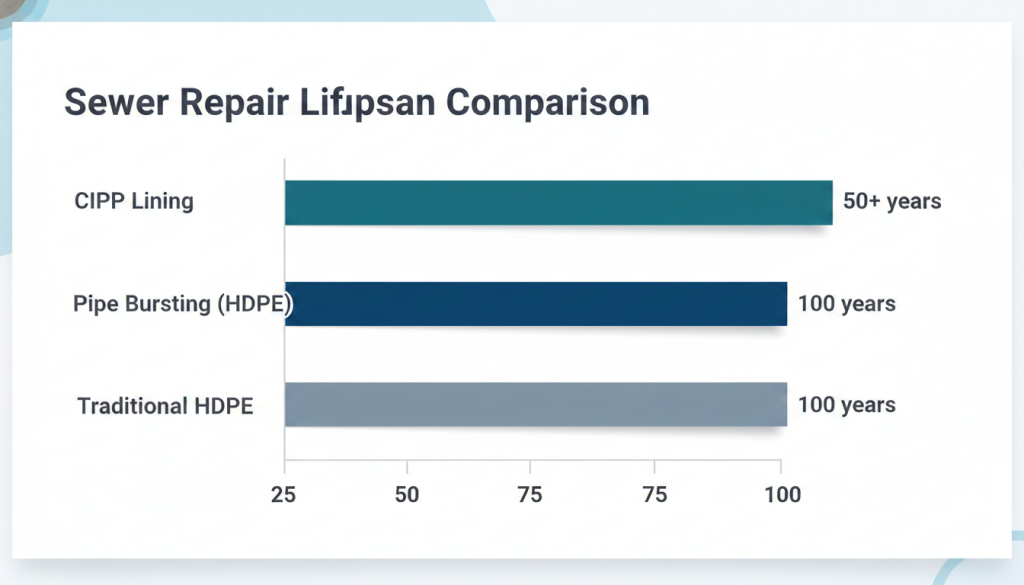
When you compare apples to apples, trenchless holds its own — and frequently outperforms — newly excavated traditional pipe replacement.
| Repair Type | Material | Typical Lifespan |
| Traditional excavation + new PVC | Schedule 40 PVC | 50–100 years |
| Traditional excavation + new HDPE | HDPE | 50–100 years |
| Trenchless CIPP lining | Felt/fiberglass + resin | 50+ years |
| Trenchless pipe bursting | New HDPE | 50–100 years |
There’s a common myth that “real” replacement (digging up the yard) lasts longer than trenchless. The data doesn’t support it. The materials used in trenchless are engineered to the same standards — and in some cases the same materials (HDPE pipe bursting is literally installing brand-new HDPE pipe, just without the trench).
What changes is what’s around the pipe. Trenchless leaves the host pipe and surrounding soil structure undisturbed. Traditional excavation disturbs soil, creates backfill that can settle over time, and risks damaging adjacent utilities. Both approaches age — they just age in different ways. For the full cost-and-tradeoff comparison see our Trenchless vs. Traditional Digging in Charlotte: Cost & Pros/Cons guide.
What factors actually affect how long trenchless lasts in real life?
Engineered design life and actual service life aren’t always the same. Five factors move the needle most:
1. Condition of the host pipe before lining. A CIPP liner installed in a structurally intact older cast iron line is going to outperform a liner installed in a partially deteriorated Orangeburg pipe. The honest call is sometimes to burst rather than line — which is why diagnosis comes first.
2. Soil stability and ground movement. Charlotte’s red clay soils are mostly stable, but properties on slopes, near creek beds, or in areas with significant grading work can experience ground shifts that stress any underground pipe over decades. CIPP and HDPE both handle moderate ground movement well; severe shifts are different.
3. Installation quality. ASTM F1216 specifies how the liner is mixed, inserted, inflated, and cured. Variations in resin mix ratios, cure temperature, or wet-out time can dramatically affect long-term performance. This is why who installs it matters as much as the spec on paper.
4. Pipe size and load. Residential lateral lines (typically 4–6 inches) are well within the design envelope for ASTM F1216. Large-diameter installations have additional engineering considerations.
5. What gets put down the drain. Grease, harsh chemicals (concentrated drain cleaners), and “flushable” wipes are the three biggest enemies of any sewer line — lined or otherwise. CIPP liners are corrosion-resistant, but chronic abuse can still scale or degrade the surface over time. The same care that protects a PVC line protects a CIPP liner.
<a id=”warranty”></a>
How long is a typical trenchless sewer repair warranty?
Here’s where things get interesting. The liner is engineered for 50+ years, but the warranty you’ll actually get from a contractor is usually shorter — and that’s not necessarily a red flag, as long as you understand what’s being covered.
Typical warranty ranges for residential trenchless work:
| Warranty Length | What It Usually Means |
| 5 years or less | Bare-minimum coverage; treat with caution unless installer explains why |
| 10 years | Common industry standard for established contractors |
| 15–25 years | Strong warranty — typical of contractors with high confidence in their workmanship |
| Lifetime / transferable | Best-in-class — usually backed by both the contractor and the material manufacturer |
What you want to ask:
- Is the warranty transferable if you sell the home? (Big deal for resale value.)
- Does it cover materials only, or labor too?
- What are the exclusions? Watch out for sweeping clauses that exclude the most common failure modes (roots, settling, corrosion).
- Is there a separate manufacturer warranty on the liner itself? (Many epoxy systems carry 50+ year material warranties from the manufacturer, separate from the installer’s labor warranty.)
The shorter warranty isn’t dishonest — it reflects the contractor’s exposure on labor over time, not the lifespan of the product. A 10-year labor warranty on a 50-year liner is a normal, reasonable structure. A 5-year warranty with broad exclusions on a “lifetime” claim is not.
What can shorten the lifespan of a trenchless repair?
Even properly installed trenchless work can fail prematurely if the conditions are wrong. The most common reasons real-world installations underperform:
- Lining over a pipe that should have been burst or excavated — putting a liner inside a fully collapsed or severely off-grade pipe is a short-term fix that fails fast
- Poor resin cure — undercured liners can delaminate or develop soft spots in the first 1–10 years
- Soil movement / sinkholes — severe ground shifts can stress even a structural liner past its design parameters
- Unaddressed root systems near the pipe — while CIPP resists root intrusion much better than old joints, large root masses pressing against the pipe from outside can still cause issues over time. (Tree roots cause more than 50% of all sewer blockages per peer-reviewed research from the USDA Forest Service — the rate of intrusion drops dramatically after CIPP, but it doesn’t drop to zero in every soil and tree-density situation.)
- Improper diameter or thickness specs — the liner has to be engineered to handle hydrostatic and soil loads at the depth and diameter of the host pipe; cutting corners on thickness shortens life
- Chronic chemical or grease abuse — sustained exposure to harsh chemicals or grease buildup degrades the liner surface over decades
Most of these are installer or diagnosis errors — they reflect the work, not the technology. ASTM-compliant installations from experienced contractors rarely encounter these issues.
How can homeowners extend the life of a trenchless repair?
Once the work’s done, there are five high-leverage habits that protect your investment for the full 50+ year design life:
- Schedule a follow-up camera inspection at year 3–5, then every 5–10 years. Cheap insurance — you’ll catch any issues while they’re still in warranty and easy to address.
- Don’t pour grease, fats, or oils down the drain. They cool, harden, and stick to any pipe surface — including a CIPP liner.
- Skip the “flushable” wipes. They don’t break down the way toilet paper does and they’re a leading cause of recurring blockages.
- Avoid harsh chemical drain cleaners. Most modern liner resins are chemical-resistant, but sustained exposure to caustic drain cleaners can eventually degrade the surface. Mechanical cleaning (hydro jetting) is safer.
- Manage trees and root systems within 20 feet of the sewer line. Lined pipes resist root intrusion, but you can extend that resistance further by selecting non-aggressive species and doing periodic root pruning.
The smooth, jointless interior of a CIPP liner actually makes maintenance easier than maintaining an older clay or cast iron line — there are far fewer rough spots and joints for debris to catch on.
Is trenchless sewer repair really permanent?
This is the question most homeowners are really asking when they search “how long does trenchless last.” The honest answer:
No underground infrastructure is truly “permanent” — but trenchless sewer repair is one of the longest-lasting plumbing investments you can make in your home.
A 50-year design life means most homeowners who install a trenchless repair today will not need to touch their sewer line again during their ownership of the home. Even at the conservative end of the range (40 years), you’re looking at decades of reliable service.
For context: the city of Greenville’s CIPP specification requires a 50-year design life on municipal sewer rehabilitation projects — meaning utilities are confident enough in trenchless to bet seven-figure budgets on it. The same engineering applies to a residential lateral.
The right way to think about it: trenchless sewer repair is a generation-spanning fix, not a temporary one. If you’re staying in your Charlotte home for the next 10, 20, or even 40 years, a properly installed trenchless repair is unlikely to ever come back as a problem.
Call to Action
Want a sewer repair you won’t have to think about for 50 years? Pipeworks Plumbing & Drain installs trenchless sewer repairs to ASTM F1216 standards, backed by clear written warranties and a sewer camera inspection that documents every defect before and after the work. No guesswork, no marketing math — just a structural fix engineered to outlive the home it’s under.
📞 Call (704) 555-0000 or request a sewer camera inspection online →
Conclusion / TL;DR
- Trenchless sewer repair is engineered for 50+ years under ASTM F1216 international engineering standards.
- The 50-year figure is not marketing — it’s a design specification with documented long-term flexural modulus testing (ASTM D2290).
- CIPP lining and pipe bursting both deliver decades of service. Pipe bursting installs new HDPE rated for 50–100 years.
- Trenchless lifespans match or exceed newly excavated PVC pipe in almost every residential scenario.
- Real-world lifespan depends on host pipe condition, soil stability, installation quality (ASTM compliance), pipe sizing, and what gets put down the drain.
- Typical warranties run 10–25 years — shorter than the engineered lifespan, but that reflects labor exposure, not product life.
- You can extend the life with periodic camera inspections, no grease/wipes/harsh chemicals, and tree management near the line.
- It’s not literally permanent, but for most Charlotte homeowners, a properly installed trenchless repair is a once-in-a-generation fix.