

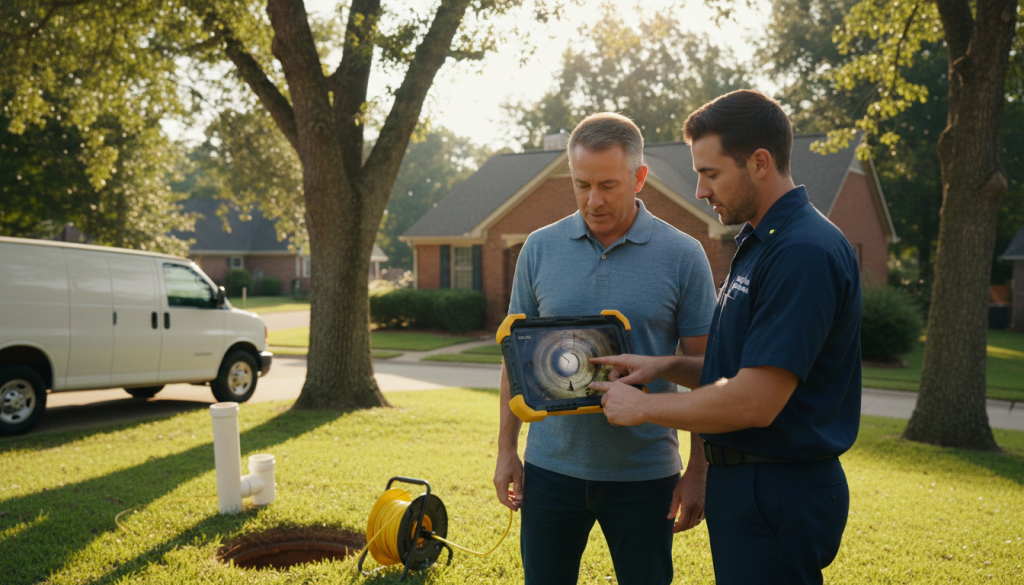
If your Charlotte sewer line has a single isolated crack, a small root intrusion, or a localized blockage — and the rest of the pipe is structurally sound — you likely need a spot repair, hydro jetting, or a sectional fix, not a full trenchless replacement. A full trenchless repair (CIPP lining or pipe bursting) is only appropriate when damage is widespread, the pipe is severely corroded across multiple sections, or the line is failing throughout. The only honest way to know which one you need is a sewer camera inspection from Pipeworks Plumbing & Drain — the camera shows the actual condition of your pipe, end to end, before anyone quotes you a job.
What’s the difference between a sewer “repair” and full trenchless replacement?
A lot of homeowners think every sewer problem means digging up the yard or replacing the whole line. It doesn’t.
There are actually four different levels of fix for a damaged sewer pipe, ranging from least invasive to most:
- Drain cleaning / hydro jetting — clears blockages, grease, and small roots. No pipe work.
- Spot repair (point repair) — fixes a single, localized section of pipe (typically 2–4 feet) without touching the rest of the line.
- Sectional trenchless repair — replaces or relines a longer segment (10–30 feet) using CIPP or pipe bursting through small access points.
- Full trenchless line replacement — relines or bursts the entire sewer lateral from house to city main, end to end.
The right answer depends entirely on what the sewer camera shows. Spot repair works when damage hasn’t spread. Full trenchless replacement is for systemic failure across most of the line. Anyone quoting option 4 without first running a camera through your pipe is guessing — or selling.
When do I only need a spot repair?
A spot repair (also called point repair or selective repair) is the right call when the damage is contained to one section and the rest of the line is structurally sound. This is more common than most homeowners realize.
You’re a candidate for spot repair if the camera inspection shows:
- A single isolated crack in one section of the pipe
- Minor root intrusion at one joint (not throughout the line)
- A small offset or settled section affecting one piece of pipe
- Localized corrosion that hasn’t spread to adjacent sections
- A single broken or displaced fitting at a known location
- Damage caused by a recent event — for example, ground settling, a tree falling, or construction nearby
In these cases, a plumber can fix just the affected section (often via a short trenchless point liner or a small dig at the exact damage location) and leave the rest of your line untouched. Hydro jetting may be added to clean out residual debris, but the fix itself is contained. For background on how cleaning fits into this, see Pipeworks’s page on hydro jetting services.
When do I actually need full trenchless replacement?
Full trenchless replacement (lining or bursting the entire line) is the right call when multiple problems exist along the length of the pipe — meaning a spot repair would just kick the can down the road.
You likely need full trenchless replacement if the camera shows:
- Widespread cracks or fractures across multiple sections
- Severe root intrusion at multiple joints along the line
- Pipe-wide corrosion — common in older cast iron lines past their service life
- Failing pipe material — particularly Orangeburg pipe, which deteriorates structurally as a system, not in isolated spots
- Recurring backups even after multiple cleanings or spot fixes
- The pipe is 40–60+ years old and made of clay, Orangeburg, or aging cast iron
The key distinction: full replacement makes sense when fixing one problem just exposes another. If the camera reveals 3+ defects in different sections, paying for three spot repairs is usually worse value than one trenchless reline of the entire run.
For the cost side of this decision, see our companion guide: Trenchless Sewer Repair vs. Traditional Digging in Charlotte: Cost & Pros/Cons.
What about hydro jetting — is that ever enough on its own?
Yes — but only for the right kind of problem.
Hydro jetting uses high-pressure water (up to 4,000 PSI) to scour the inside of the pipe, blasting through grease, scale, debris, and small to moderate root intrusions. It’s a maintenance and cleaning service, not a structural repair.
Hydro jetting alone is enough when:
- The pipe is structurally intact (camera confirms no cracks, breaks, or offsets)
- The blockage is caused by buildup, grease, or fine roots the water can shear off
- You’re dealing with slow drains across multiple fixtures but no backups
- You want preventive maintenance on an aging line that hasn’t yet failed
Hydro jetting is NOT enough when:
- The pipe has structural damage (cracks, holes, offsets) — water pressure won’t fix that
- Roots have already broken through the pipe wall — they’ll grow back within months
- The pipe is collapsed or partially crushed
Bottom line: hydro jetting is the right starting point for some homeowners and totally unnecessary for others. The camera tells the difference. The same applies to broader drain issues throughout the home — cleaning vs. repair vs. replacement should always be camera-guided.
How do contractors decide? (The diagnosis framework)
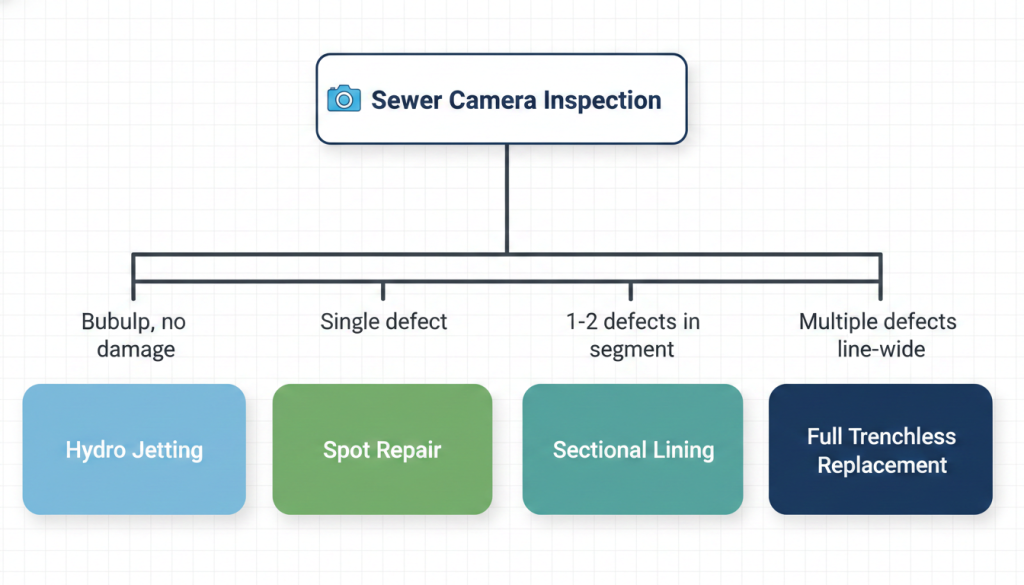
Here’s the honest decision framework Pipeworks uses — and what any reputable Charlotte sewer contractor should walk you through:
| Camera Inspection Finding | Recommended Solution |
| Localized blockage, no structural damage | Drain cleaning or hydro jetting |
| Single crack or fitting failure, rest of pipe sound | Spot/point repair |
| 1–2 isolated defects within a 10–30 ft section | Sectional CIPP lining |
| Multiple defects spread across the line | Full trenchless lining |
| Pipe collapsed, severely off-grade, or fully crushed | Traditional excavation (trenchless not viable) |
| Aging Orangeburg or end-of-life cast iron, system-wide failure | Full trenchless or full traditional replacement |
The framework is simple in principle: fix what’s actually broken, not the whole line, unless the whole line is the problem.
What you should hear from a contractor: “Here’s what the camera showed. Here are the defects. Here’s the smallest fix that solves them. Here’s why a bigger fix is or isn’t worth it.”
What’s a red flag: A quote for full trenchless replacement without a camera inspection report attached, or with a camera report that only shows one or two defects.
How can I tell if I’m being upsold?
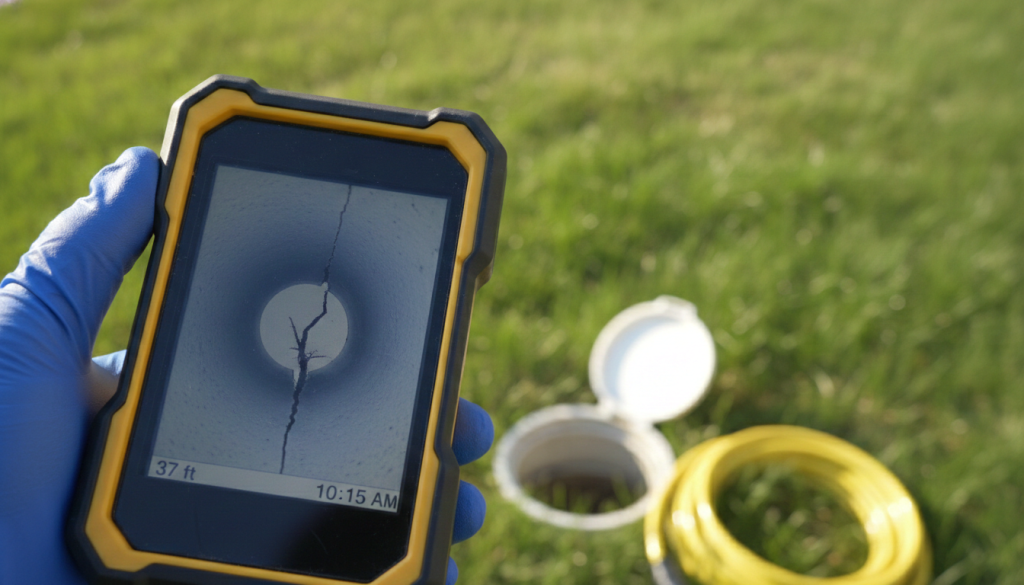
This is the question most homeowners are afraid to ask out loud. Here’s a straightforward checklist for spotting an upsell on a trenchless sewer repair:
- No camera inspection performed first. Any quote for a $10,000+ line replacement without a recorded video of your pipe is a red flag. Period.
- Camera report shows only 1–2 isolated defects, but you’re being quoted full replacement. That’s a math problem — three spot repairs are almost always cheaper than one full reline if defects are truly localized.
- The contractor refuses to show you the camera footage. A reputable plumber will play the video back for you and timestamp the defects.
- You’re told “trenchless is always better, so just do the whole line.” Trenchless is a method, not a guarantee that the whole line needs work. The condition of the pipe should drive the scope.
- The estimate includes “preventive replacement” language for sections the camera didn’t flag. Preventive maintenance is a thing — preventive replacement of pipe sections that show no defect usually isn’t.
- Pricing is quoted before the inspection is done. Real diagnostic work has to come before real pricing.
If you’ve been quoted full trenchless and want a second opinion based on the actual pipe condition, that’s a reasonable thing to ask any Charlotte plumber for. Pipeworks’s track record on this is publicly available — see customer reviews and testimonials.
This emphasis on inspection before estimating echoes guidance from This Old House’s plumbing expert Richard Trethewey, who recommends sending a camera down the sewer line before any work begins to eliminate guesswork and produce an accurate estimate.
What pipe materials are most likely to need full replacement?
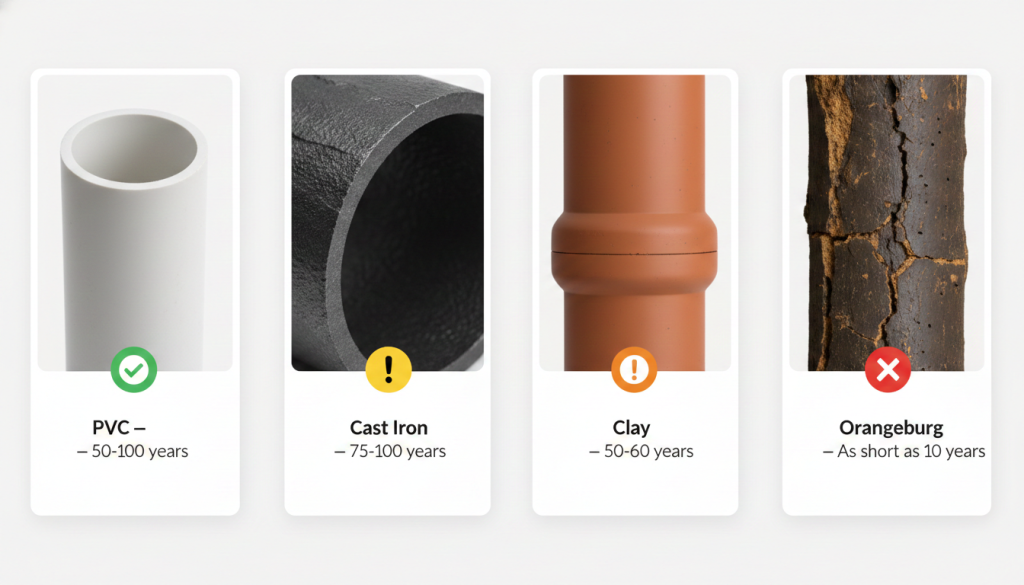
The age and material of your existing sewer line is one of the strongest predictors of whether spot repair will hold up — or whether you’re better off replacing the whole run while everything’s open.
| Pipe Material | Era Used | Typical Lifespan | Spot Repair vs. Full Replacement |
| PVC | 1970s–today | 50–100 years | Spot repair almost always works |
| Cast iron | Pre-1980 | 75–100 years | Spot repair if young; full replacement if widespread corrosion |
| Clay (vitrified) | Pre-1960 | 50–60 years | Spot repair on isolated joints; full replacement if multiple joints failing |
| Orangeburg | 1860s–1970s | As short as 10 years in poor conditions | Almost always full replacement — material fails systemically |
If you’re in an older Charlotte neighborhood — Plaza Midwood, Dilworth, NoDa, parts of Elizabeth, or any pre-1970 home in Mecklenburg County — there’s a real chance your sewer lateral is clay, cast iron, or Orangeburg. Knowing what you have changes the conversation. Browse the pipe materials overview for visual examples of each.
A peer-reviewed review published in the Journal of Infrastructure Systems by the USDA Forest Service Research found that tree roots cause more than 50% of all sewer blockages — and that older pipes with joints (clay, cast iron, Orangeburg) are by far the most vulnerable to root intrusion. That data alone explains why spot repair is often realistic on a newer PVC line but rarely the right call on a 60-year-old clay system.
What does each option cost in Charlotte, NC?
Realistic 2026 price ranges for Charlotte and the surrounding Mecklenburg County area:
| Service | Typical Cost Range |
| Sewer camera inspection | $175 – $350 |
| Hydro jetting (one cleaning) | $400 – $900 |
| Spot/point repair | $1,500 – $4,000 |
| Sectional trenchless lining | $3,000 – $7,000 |
| Full trenchless line replacement | $8,000 – $15,000 |
| Traditional excavation full replacement | $5,000 – $20,000+ (with restoration) |
The takeaway is hard to miss: a $2,000 spot repair on a sound line is dramatically cheaper than an $11,000 full reline that wasn’t actually necessary. That’s why a real diagnosis matters more than the sales pitch.
For homeowners in surrounding areas, Pipeworks serves multiple counties across Western North Carolina with the same diagnosis-first approach.
Call to Action
Don’t pay for a fix bigger than your problem. Pipeworks Plumbing & Drain runs a full sewer camera inspection before quoting any repair work — and we’ll walk you through the footage, timestamp the defects, and recommend the smallest fix that actually solves the problem. No upsell pressure, just a clear diagnosis.
📞 Call (704) 555-0000 or request a sewer camera inspection online →
Conclusion / TL;DR
- Not every sewer problem needs full trenchless replacement. Spot repair, hydro jetting, or sectional fixes are often enough.
- Spot repair works when damage is isolated to one section and the rest of the pipe is structurally sound.
- Full trenchless replacement makes sense when defects are spread across the line, the pipe material is failing systemically, or recurring backups continue after multiple repairs.
- Hydro jetting alone is enough only when the pipe is structurally intact and the issue is buildup or fine roots — not cracks or breaks.
- Always demand a camera inspection before any quote. No camera footage = no honest estimate.
- Older pipe materials (Orangeburg, aging cast iron, pre-1960 clay) are far more likely to need full replacement than modern PVC.
- Watch for upsell signals: no inspection, refusal to share footage, “preventive replacement” language, full-line quotes when only 1–2 defects exist.