

Water Service Line Replaced at an Occupied Multi-Family Community in Lenoir, NC — Landscaping Left Standing
At a multi-family community in Lenoir, North Carolina, a failing water line ran the length of the building fronts — tight against the foundations, buried inside mature shrub beds, on a graded slope. Residents were home the whole time. Here is exactly how the job was diagnosed, sequenced and executed.
Project Overview
A Failing Water Line, in the Worst Possible Place
Replacing a water service line is not usually difficult work. Replacing one that runs along the foundations of occupied homes, inside established landscaping, on a slope, is a different job entirely — and the difficulty has almost nothing to do with the pipe.
Lenoir sits on the heavy red clay that runs through the Caldwell County foothills. It holds a trench wall well, which helps, but it is unforgiving to work in and it stains everything it touches. Combine that with buildings set into a hillside and a water line threaded between the foundations and the planting, and the excavation becomes the hard part of the project rather than the plumbing.
Aged pipe, repeating failures
The line being replaced had reached the end of its usable life. In the excavations you can see the pipe that came out: rust-stained, scaled steel, sitting beside the clean new run that replaced it. That is the signature of a service line that has been patched before and will need patching again.
There is a point where repair stops being economical. Each new leak means another excavation, another restoration bill, another interruption to residents — and the failures cluster, because the whole run is the same age and in the same condition. Once a line starts failing in more than one place, replacement becomes the cheaper decision even though it looks like the bigger one.
The pipe lifted out of this trench tells that story on its own: heavy external corrosion and scale along its length, not a single clean failure point.
The line ran where there was no room to work
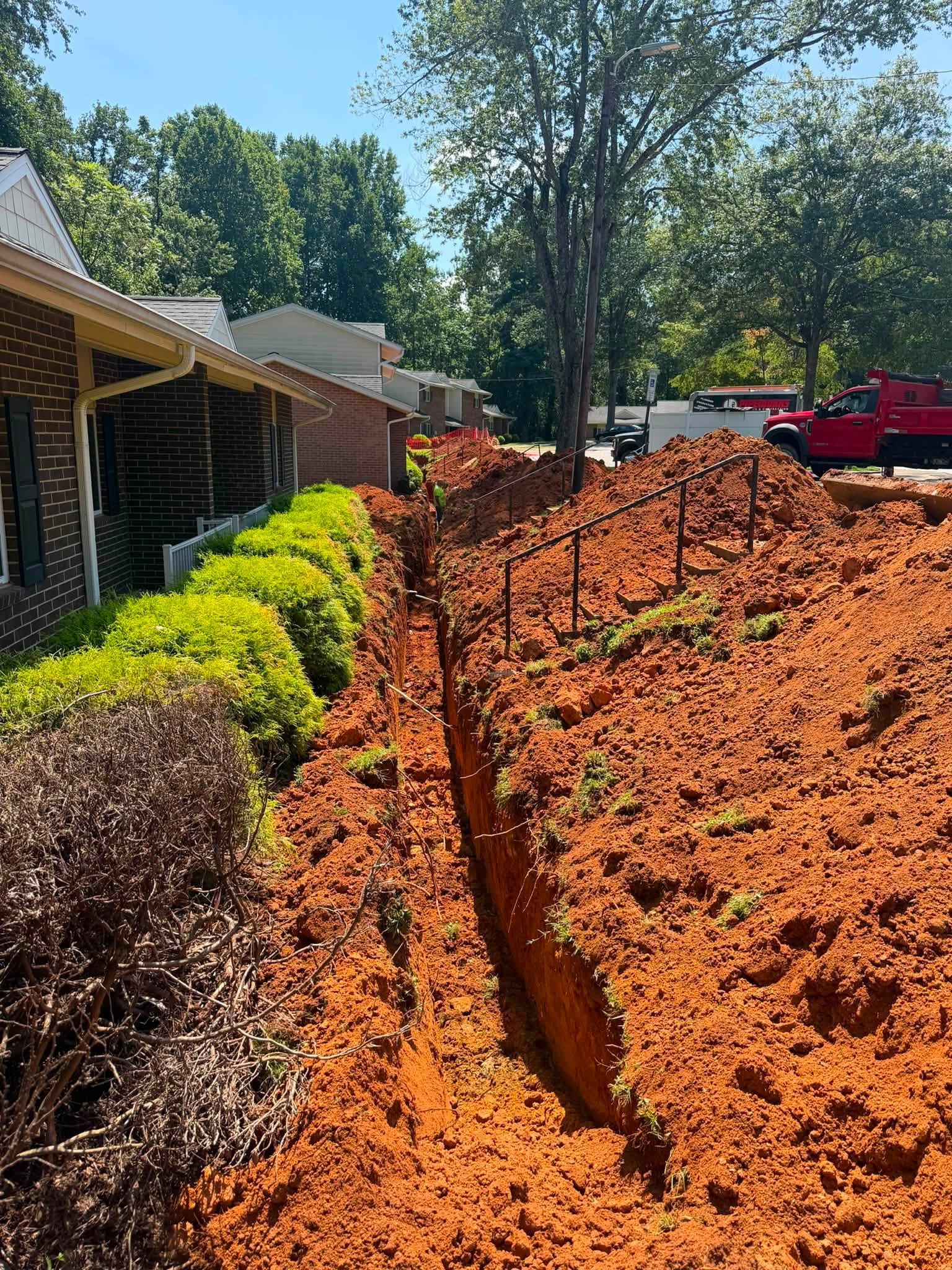
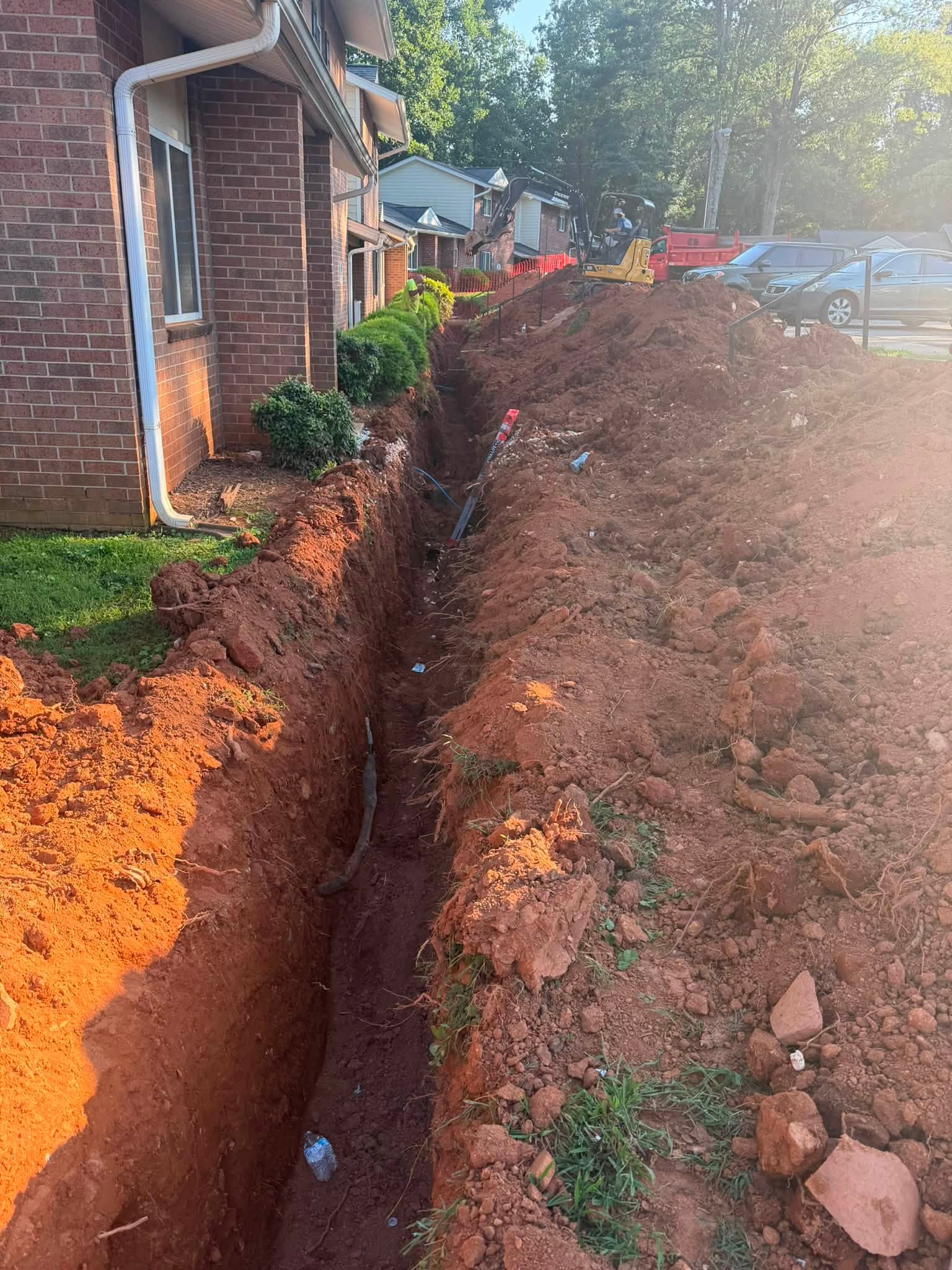
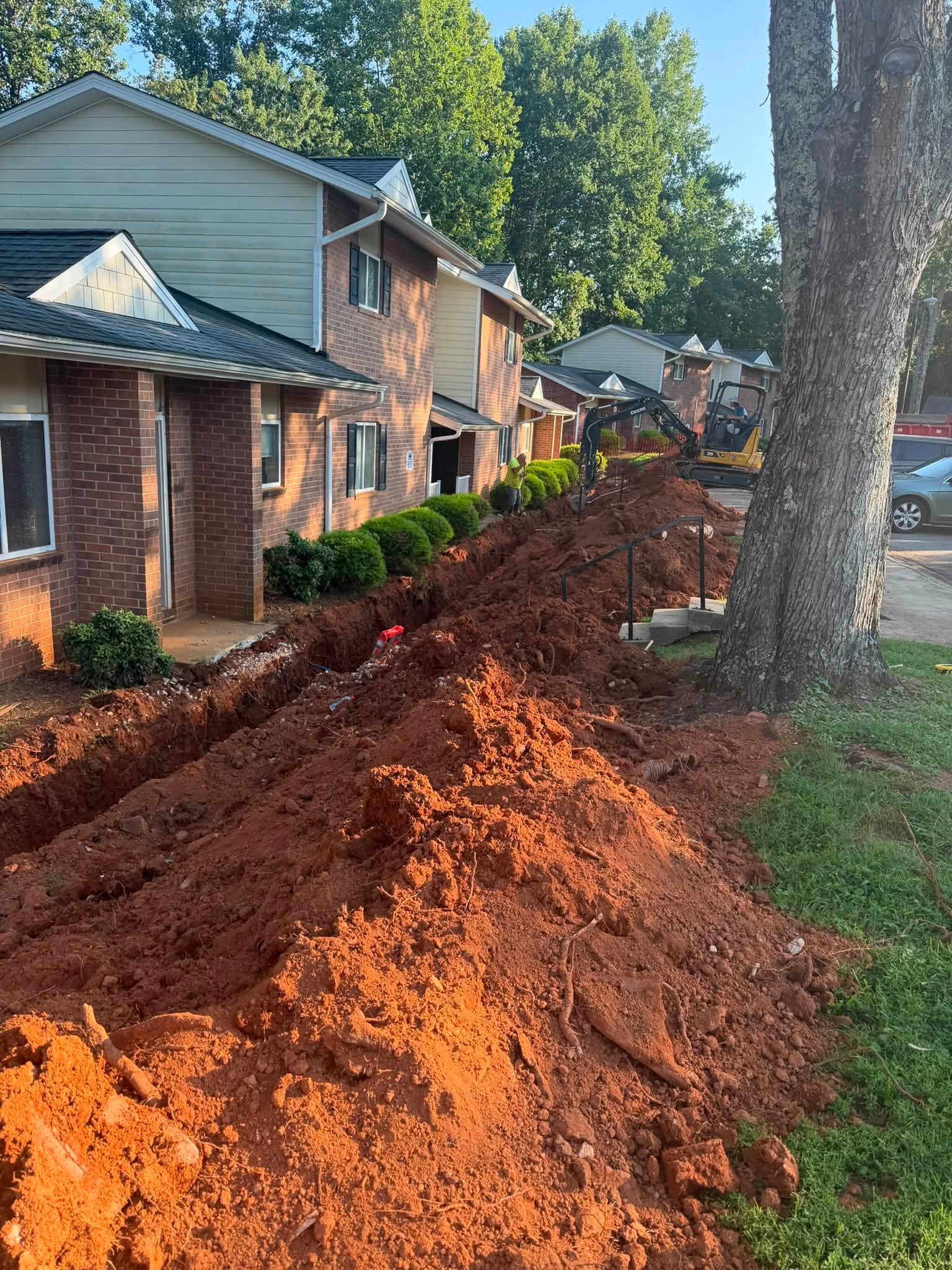
The route hugged the building fronts — inches from brick, threaded between the foundation wall and a continuous row of mature shrubs, on ground that falls away steeply toward the parking areas. Concrete step runs and steel handrails cross the line at intervals.
A conventional wide machine cut through that corridor would have taken the shrub beds, undermined the steps and left the property with a landscaping bill on top of a plumbing one.


Residents were living there the entire time
This was not a vacant building or a construction site. Cars stayed in the lot, doors stayed in use, and people came and went past an open trench every day the job ran.
That single fact reshapes everything. Excavations have to be fenced, not just coned. Walkways have to stay usable, including the accessible routes. Spoil cannot be piled across an entrance. Machines cannot swing over a path someone is about to use. And water cannot simply be shut off at the meter for a week while the work gets done — every hour without water becomes a call to the property manager.
Most contractors price this work as though the property were empty, then discover the constraint on day one. For a manager or an HOA board, the risk is not really the pipe. It is disruption: complaints, damaged landscaping, blocked parking, and a project that drifts because nobody planned around the people living on top of it.
Diagnose First. Then Dig Only Where It's Needed.
Every decision on this project came back to one principle: the less ground you open, the less there is to put back. That starts long before the first bucket of clay comes out.
Camera inspection before excavation
A pipeline inspection camera went in before anything was dug. Scoping the line first turns an unknown into a located, confirmed fault — which means the excavation can be sized to the actual problem instead of trenching across a property hoping to find it.
It is the same discipline behind our CCTV drain camera inspections and our leak detection work: look before you open.
Locates, permits and utility clearance
Before excavation on a property with buried power, gas, communications and irrigation running alongside the water line, everything gets marked. Utility locates were called in and the route walked against the marks.
Locates before the machine arrives is not optional on a property like this, and it is part of what separates a licensed utility contractor from a crew with an excavator.
Phased, building by building
Rather than opening the full run at once, the work advanced in sections. Only the length being actively worked was isolated and exposed; everything behind it was backfilled and everything ahead of it was undisturbed.
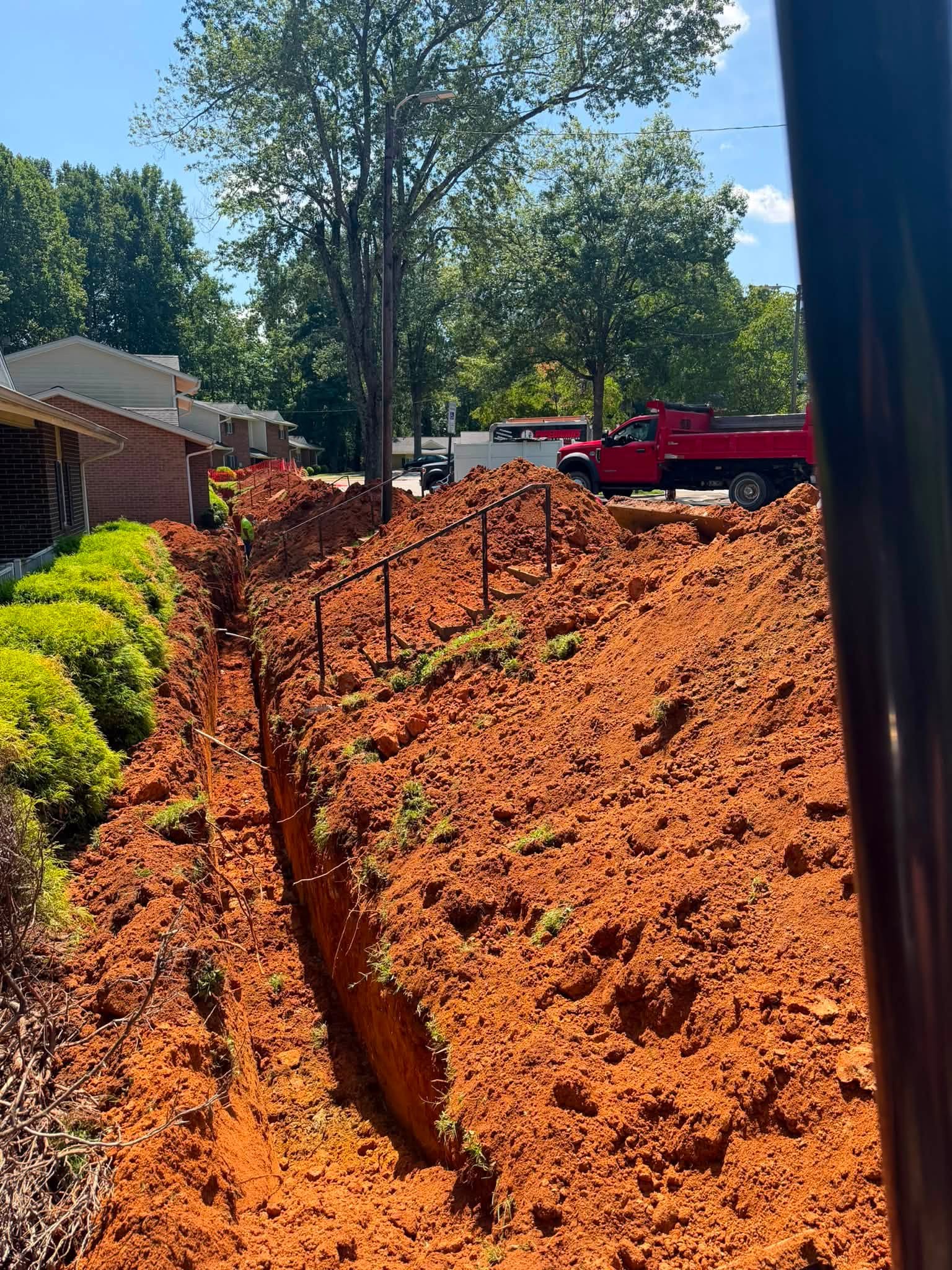
That keeps the fenced footprint small and keeps parking and walkways available. In the project photographs you can see it — the fencing and the open ground move along the property between frames, rather than the whole run sitting open at once.
Machine cut, hand finish
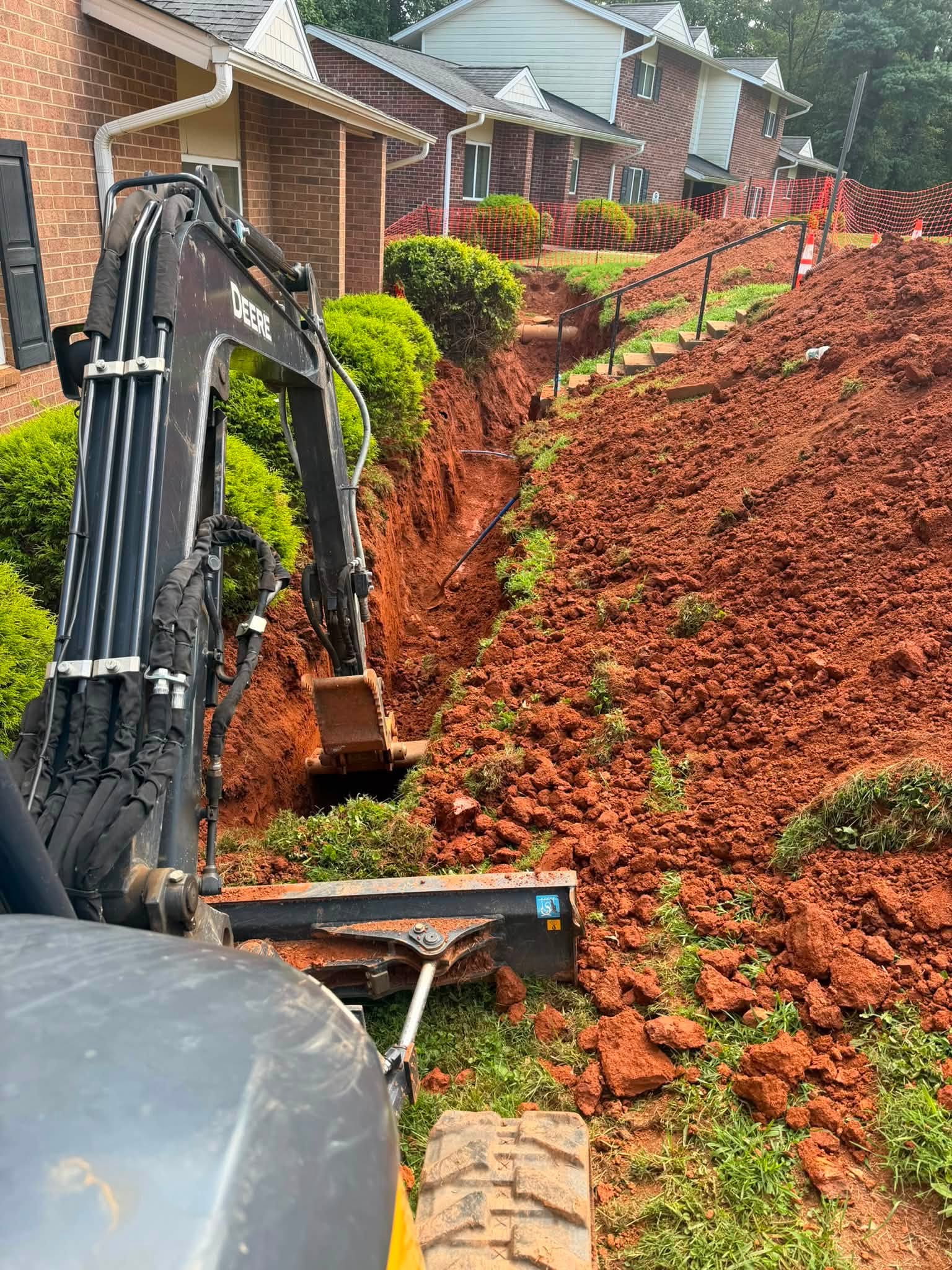
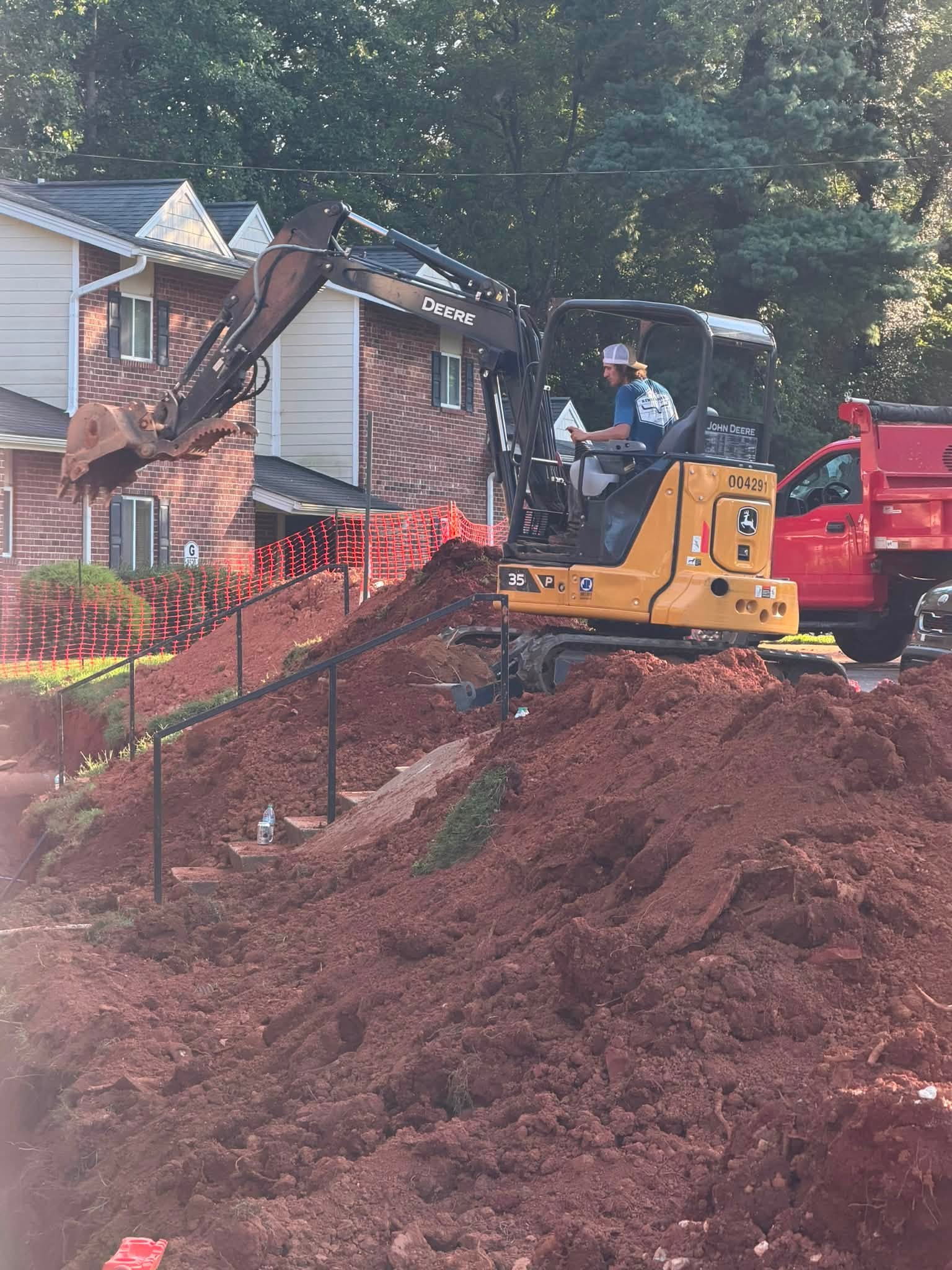
A compact excavator did the bulk cutting — small enough to sit in the corridor between the wall and the shrub line without needing to widen it. The last few inches, and everything near foundations, root balls and marked utilities, came out by shovel.
Slower per foot. Considerably cheaper than replacing a mature shrub bed, a set of concrete steps and a handrail run.
Why open-cut was the right call here
Pipeworks also runs horizontal directional drilling and cured-in-place pipe lining, and both were considered. Neither was the right tool for this line.
Lining rehabilitates a pipe that still has structural integrity — it is not a fix for a corroded service line that needs full replacement, and it does nothing for undersized pipe. Directional drilling earns its keep on long uninterrupted runs beneath something you cannot disturb, like a road or a slab. This route was shallow, followed the buildings, and needed multiple tie-ins and connections along its length. Access to every one of those points mattered more than surface preservation.
So the honest answer was the traditional one: open the ground, but open as little of it as possible, and be disciplined about putting it back. Choosing the less impressive-sounding method because it is the correct one is part of the job.

How the Replacement Was Carried Out
Locate and confirm the failure
The pipeline camera went in first, on undisturbed ground, to establish where the line had actually failed rather than where it was assumed to have failed. Utility locates were called and the route marked out against the buildings.
This is the step that determines the cost of everything after it. A confirmed fault location means a targeted excavation; an unconfirmed one means exploratory digging, and exploratory digging on a landscaped, occupied property is where budgets disappear.
Set up the site and protect what stays
Before the ground opened, the work zone was fenced and separated from resident walkways and parking with orange safety fencing, cones and caution tape. Finished surfaces that had to survive the job — the brick retaining wall cap, the concrete drive apron — were sheeted over with poly before any spoil was moved.
Covering a wall costs a few minutes. Cleaning red clay out of brickwork, or replacing a stained concrete apron, costs considerably more than that.

Open the connection pit and isolate the line
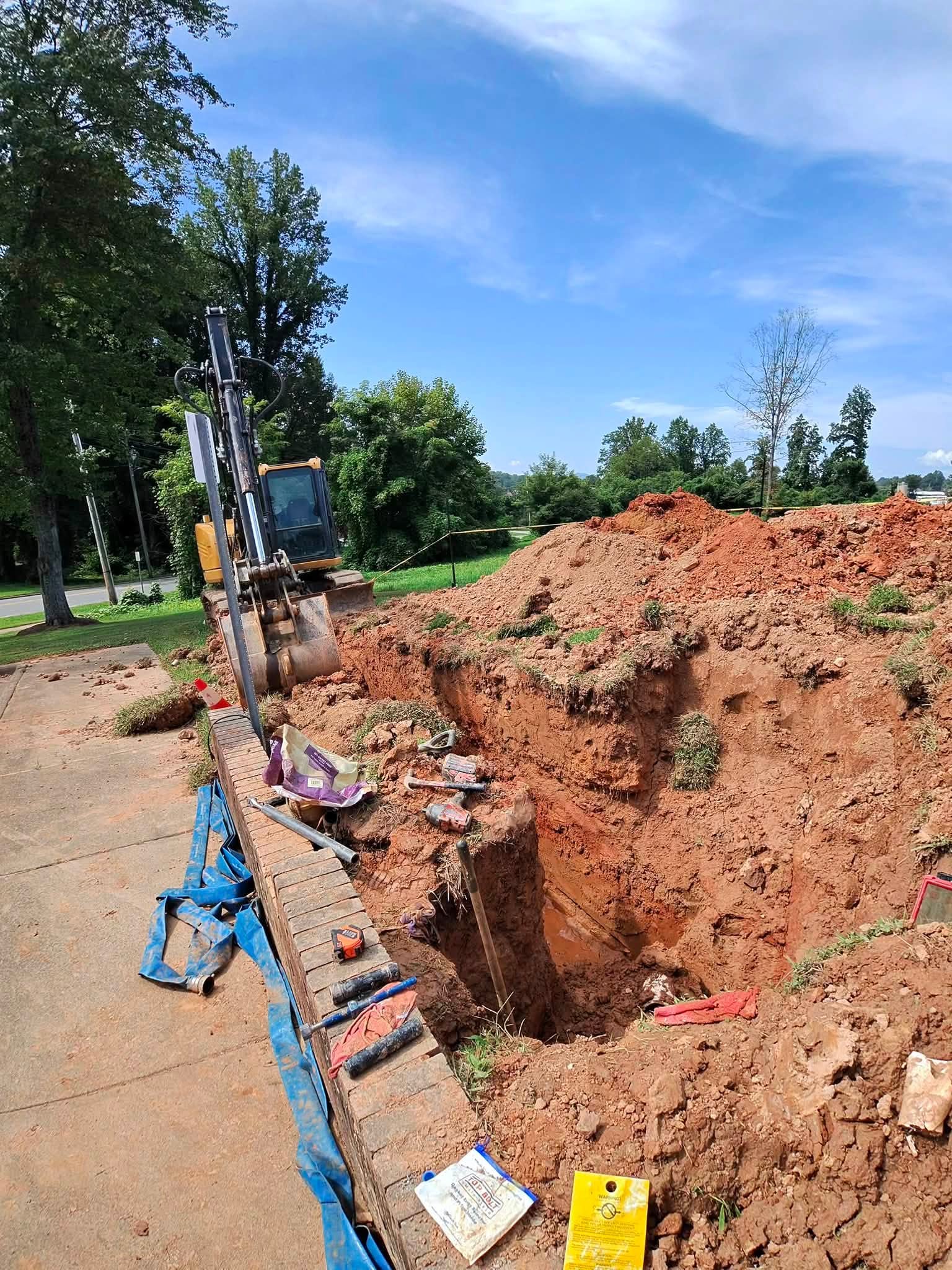
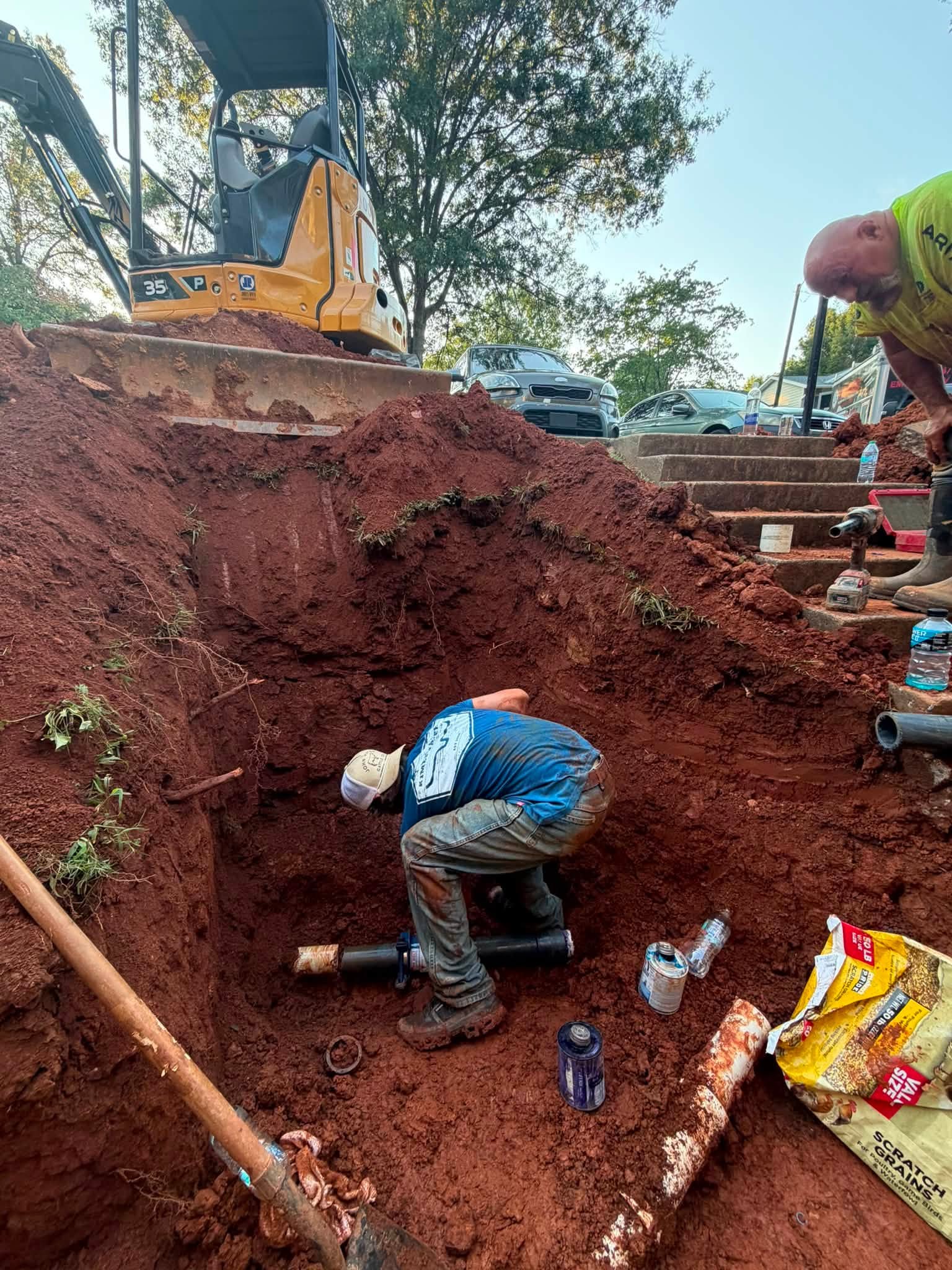
A deeper pit was opened at the drive apron to reach the connection point and set the valve, giving control over what was live and what was isolated for the rest of the project. Fittings, couplings and the valve assembly were staged at the edge of the pit before the line was broken into, so the open-pipe window stayed as short as possible.
Excavations at this depth are the ones that go wrong. Staging the parts first is how you keep a shut-off measured in hours rather than in half-days spent waiting on a fitting.

Cut the trench along the building run
A compact excavator worked the narrow corridor between the foundations and the shrub line, advancing in sections. Spoil was windrowed on the downhill side rather than spread across walkways, and cut sod was stockpiled separately from the subsoil so turf could be relaid rather than bought in.
Separating turf from clay is a small habit that shows up at the end of the project, when the ground goes back looking like ground instead of like a repair.
Hand-finish at the foundations and root balls
Wherever the trench met a foundation wall, a marked utility crossing, a step footing or a shrub root ball, the excavation finished by shovel. Crews worked the last inches by hand along the whole building frontage.
Look at the photographs from this stage and the point makes itself: an open trench, and immediately beside it, an unbroken run of mature shrubs still standing in place.

Lay the new line and tie in
New water service pipe was set in the trench and joined to the existing steel with bolted mechanical transition couplings — the correct connection for mating new pipe to aged metal, because it accommodates the dimensional and material difference instead of forcing it.
In the tie-in photographs the contrast is plain: clean new pipe with a new coupling on it, and directly below, the rust-stained line it replaced.
Bolted couplings are the right answer here rather than the fast one. They clamp and seal across a dimensional and material change instead of forcing two dissimilar pipes to meet, which is exactly the joint that leaks first when it is improvised.

Test, commission, backfill and restore
Once the new run was joined, the line was brought back into service and the trench closed — bedded, backfilled in lifts, compacted, and the stockpiled turf relaid over the top.
Backfilling in lifts matters more than it sounds. Clay dumped back in one go will settle for years, leaving a depression along the whole run that telegraphs exactly where the trench was — and on a slope, a settled trench becomes a drainage channel pointed at the foundations. Related work sits under our site preparation and grading service.
The turf cut at the start of the job came back over the top of it. That is the whole reason it was stockpiled separately from the clay in step four — so the finished ground reads as ground rather than as a repair strip running the length of the buildings.

What the Property Got Back
A line that stops failing
The corroded run is gone. In its place is a continuous length of modern service pipe that does not scale or rust from the inside out, rated for decades rather than months of patching. The repeat-repair cycle ends, and with it the excavation-and-restoration bill that arrived every time.
A property that still looks like itself
This is the result that is easiest to see and hardest to buy. The shrub beds along the building fronts are intact. The concrete step runs and steel handrails are where they were. The brick retaining wall and drive apron came through clean under sheeting.
Utility work on a landscaped property usually leaves a scar that takes a season or two to disappear, and a separate landscaping invoice to go with it. Here the restoration was part of the plan rather than a consequence of the excavation.
Residents who stayed put
Nobody was relocated. Nobody lost access to their door, their walkway or their parking space for the duration. Water came off in managed sections rather than across the whole property, which is the difference between a scheduled inconvenience and a building full of complaints.
Working around people rather than through them is a scheduling problem, not a plumbing one — and it is the part of a project like this that has to be solved before the first machine arrives, not improvised on day three.
What it saves over the next decade
The number worth putting in front of an owner or a board is not the invoice for this project — it is the spend it removes. A failing service line bills a property repeatedly: the emergency call-out, the excavation, the restoration, the water lost through the leak and paid for on the utility bill, and the administrative cost of handling every round of resident complaints.
Replacing the run converts an unpredictable, recurring cost into a single known one, and resets the clock on the asset by decades rather than months. That is the calculation that makes replacement defensible in a budget meeting — and it is usually the one that has not been done, because the individual repairs each looked small at the time.

| Metric | Result |
|---|---|
| Location | Lenoir, Caldwell County, North Carolina |
| Property type | Occupied multi-family residential, attached buildings on a graded site |
| Scope | Water service line replaced across multiple building frontages |
| Diagnostics | Pipeline camera inspection before excavation |
| Excavation method | Open-cut; compact machine cut, hand-finished at foundations and root balls |
| Tie-ins | Bolted mechanical transition couplings to the existing steel line |
| Resident displacement | None — property occupied throughout |
| Landscaping and hardscape damage | None — shrub beds, steps, handrails and brickwork preserved |
What Our Customers Say
We would rather point you at the record than at a slogan. Our reviews and testimonials are collected in one place, and our Google Business Profile carries them unedited.
The Job, Start to Finish
Photographed on site as the work progressed — diagnostics, connection pit, trenching along the buildings, tie-ins, and the finished run before backfill.
Repair Again, or Replace? Five Signals
Most properties do not arrive at a full replacement in one step. They arrive after a run of repairs, each one individually reasonable. These are the signals we look for when advising whether the next repair is money well spent or money spent twice.
The failures are moving, not repeating
One leak in one place is a repair. Leaks appearing at new points along the same run are a condition, not an event — the whole line is the same age, in the same soil, carrying the same water. Fixing the newest hole does nothing about the next one.
Repair cost is approaching replacement cost
Add up the last three or four repairs, including restoration and lost water, not just the plumbing invoice. On multi-family property the restoration is frequently the larger half. When that running total starts to look like a replacement quote, the decision has already been made for you.
The pipe is a material you can date
Galvanised steel, older polybutylene and certain early plastics have known, finite service lives. If the line is original to a building put up decades ago, its remaining life is a matter of arithmetic rather than opinion — and a camera inspection will confirm the internal condition.
Pressure or water quality is dropping property-wide
Single-unit complaints point at a fixture or a branch. Complaints spread across buildings point at the service line — scale narrowing the bore, or corrosion products reaching the taps. That is a whole-run problem and it will not improve.
Every repair costs you the landscaping again
This is the one that gets missed. If the line runs through planting, hardscape or paving, every future repair reopens ground you have already paid to restore. Replacing once, with restoration planned in, is cheaper than restoring four times.
Not sure which side you're on?
A camera inspection answers it in an afternoon, and it is the same first step whether the outcome is a repair or a replacement. You get a located fault and a documented internal condition either way.
Utility Work on Occupied Multi-Family Property
The same replacement can be delivered two very different ways. The pipe ends up in the ground either way; what differs is what the property looks like afterwards, and how many calls the manager takes while it happens.
| Challenge | Typical approach | The Pipeworks approach |
|---|---|---|
| Finding the failure | Dig and look | Camera-inspect first, then dig once |
| Trenching near foundations | Wide machine cut; landscaping written off | Compact machine cut, hand finish inside the shrub line |
| Resident water service | Property-wide shut-off for the duration | Phased by section, with scheduled windows |
| Site safety on an occupied property | A few cones | Fenced exclusion, walkways and accessible routes kept open |
| Finished surfaces | Spoil straight onto brick and concrete | Poly sheeting over hardscape before excavation begins |
| Spoil management | Piled on site and left | Sod cut and stockpiled for reuse; clay hauled off |
| Tie-ins to aged pipe | Improvised connections | Rated bolted mechanical transition couplings |
| Restoration | "Not in our scope" | Planned from the outset, not treated as someone else's problem |
Multi-Family Water Line Replacement FAQs
Will residents lose water during a water service line replacement?
Not for the length of the project. A replacement is sequenced so that only the section being actively worked is isolated. The rest of the property stays in service, and shut-offs are scheduled into announced windows so residents know in advance when to expect an interruption.
How do you replace a water line without destroying the landscaping?
By matching the machine to the corridor and finishing by hand. A compact excavator cuts a narrow trench, then crews hand-dig the last few inches around foundations, root balls and buried utilities. Sod is cut and stockpiled separately from subsoil so turf can be relaid rather than replaced.
Why inspect a water line with a camera before digging?
Because it converts guesswork into a known location. A camera inspection shows where the line has actually failed, so the excavation is sized to the problem instead of exploratory trenching across a property. Less ground opened means less restoration and lower cost.
What is the difference between open-cut trenching and directional drilling for a water line?
Open-cut trenching opens the ground along the pipe route, giving full access to inspect, bed and tie in the new line. Directional drilling installs pipe underground from two small pits, preserving the surface. Open-cut suits shallow lines with multiple connections; drilling suits long runs under driveways, roads or structures.
Who pays for a water service line replacement at an apartment or HOA property?
Responsibility usually splits at the meter or the property line. The utility maintains the main; the property owner or association typically owns the service line from that point to the buildings. Governing documents and the local utility's service policy decide the exact boundary, so both should be checked before work is scoped. Our guide to who is responsible for sewer and water line repair covers this in more detail.
How long does a new polyethylene water line last?
Modern polyethylene water pipe is generally rated for a service life in the region of 50 to 100 years when correctly bedded and pressure-rated for the application. It does not corrode or scale the way aged galvanised steel does, which is the usual reason older service lines begin to fail repeatedly. You can read more about the pipe materials we work with.
Water Line Failing Under an Occupied Property in Lenoir or Caldwell County?
Talk to a licensed North Carolina plumbing and utility contractor who plans the project around your residents instead of around the machine. We'll scope the line, tell you what it actually needs, and give you a schedule you can send to your tenants. We're based in Lenoir and work across Caldwell County and the surrounding foothills.
What Went Into This Project
Excavation & utilities
Multi-family & commercial
More proof of work: read our home renovation case study, delivered on time and on budget →
Where We Work
Pipeworks is based in Lenoir and serves multi-family, commercial and residential property across Caldwell County and the wider western and central North Carolina foothills.
How We Work, Every Project
- Licensed & insured
- Camera diagnostics before excavation
- Utility locates called on every dig
- Phased scheduling for occupied properties
- Landscaping protected and restored
- Clean, fenced worksites
- Multi-family & HOA experience
- Available 24 hours, 7 days
- Written warranty on installed work